

SAFE Perimeter 360° Layered Solutions
Continuous Monitoring for Cyber-Physical Threats
Cyber and physical security stopped being separate problems. A drone over the roofline, a Flipper cloning a badge, a covert camera in a boardroom, a rogue access point in a lobby — all one category: a device operating in an airspace security teams are responsible for, but likely do not have visibility to.
SAFE Perimeter 360° monitors all of it, continuously, in one picture.
- Not rip-and-replace — integrates with the cameras, credentials and screening you already run
- Sees what your network tools cannot — devices that transmit but never connect
- One correlated picture — a badge read, a camera view and an RF event become one incident
- Whitelist what belongs, blacklist what doesn't — approved devices go quiet, unknown ones raise an alert
Four Layers. One Operating Picture.
Most sites instrument the first two layers well and leave the last two dark. The gap between them is where modern incidents live.
Entry & Screening
Walk-through weapons detection, lane throughput, secondary screening procedure, and who actually enters where.
Video & Access Control
Camera coverage, credentialing, and whether the two systems are talking to each other or merely coexisting.
Wireless Spectrum
Every emitting device in the building across 300 MHz to 6 GHz — whether or not it ever touches your network.
Airspace
Drone activity over and around the site: classification, flight path, and geolocation of the operator.
The Threats That Leave No Log
None of the following produces an entry in a system you already own. They are invisible to network-layer tooling not because the tooling is weak, but because there is nothing on the network to see.
Digital Identification & Fingerprinting
Most modern crimes involve a device — a phone, a drone, a wireless emitter. RF fingerprinting turns those digital traces into investigative leads.
- Identify, track, and attribute devices present at a scene
- Narrow a suspect pool and link individuals to hardware
- Establish recurring presence and pattern of life from RF alone
Result: case-ready intelligence, with a time-stamped record that can be replayed rather than reconstructed from memory.
Covert Cameras, Flippers & Rogue Devices
Facilities increasingly depend on wireless-controlled infrastructure — access control, lighting, HVAC, camera feeds, vendor Wi-Fi. Interference or compromise of any of it is a physical security event.
- Hidden cameras and listening devices in rooms, fixtures and vehicles
- Multi-tool RF devices used against badging and building systems
- Interference that disables IP security cameras
- Unauthorized system takeovers and disruption
Result: a zero-trust wireless perimeter that preserves uptime, traceability, and readiness for coordinated response.
Crowd Safety & Incident Prevention
In high-density environments, wireless vectors can be used to trigger panic, confusion, or diversion — and panic escalates quickly in a tightly packed crowd.
- Drones over spectators or players, triggering fear
- Rogue cell sites and spoofed alerts disrupting patron communications
- Interference against emergency radios or PA systems during a crisis
Result: real-time alerting, mobile response coordination, and automated incident logging — time and data to act before an event affects safety.
Wireless Threat Monitoring
Public areas are saturated with personal and unauthorized RF devices. Unmanaged devices evade traditional security tools, creating blind spots in privacy, compliance, and safety.
- Credential theft through spoofed Wi-Fi captive portals
- Hidden RF devices in executive and VIP areas
- Bluetooth skimmers on payment terminals
- Rogue hotspots and unclassified cellular activity
Result: continuous passive visibility across Wi-Fi, Bluetooth and cellular, with threat behaviour logged into SIEM and SOAR for automated response.
Drone & Counter-UAS Threats
Public spaces are prime targets for unauthorized drones used for observation, broadcast piracy, or payload delivery. A single airborne intrusion can halt operations.
- Aircraft loitering for observation or media capture
- Unauthorized aerial footage broadcast to pirate streams
- Payload drops intended to disrupt or cause panic
Result: passive 360° RF detection of 500+ airframes including tethered types, out to 7–14 km, with flight-path tracking and operator geolocation.
Shadow IoT & Unmanaged Assets
Connected devices operate inside most organizations without IT's knowledge — building sensors, smart displays, wireless printers, vendor-installed equipment.
- Rarely patched, frequently shipping with default credentials
- Embedded radios inside equipment nobody classed as a network device
- Air-gap and no-wireless policies enforced by assumption, not measurement
Result: a complete asset inventory that includes unmanaged devices — the control requirement most frameworks assume you can meet and most organizations cannot.
Real-Time Device Intelligence
Software-defined radio sensing, cloud analytics, and an actionable dashboard — layered onto the security infrastructure you already operate.
- Software-defined radio sensing — one sensor covers 300 MHz to 6 GHz, so new protocols arrive as a software update rather than a hardware replacement.
- Cloud-enabled and customizable — sensors report to a managed cloud, with optional on-premise server. Real-time results through a dashboard configured to your operation.
- Real-time analytics — identify unauthorized IT, IoT and OT across managed and unmanaged devices, with an incident response loop built in.
- Edge risk management — AI and ML asset discovery, classification and risk profiling, with allowlist and blocklist options and location mapping.
- Exposure reporting and benchmarking — real-time maps and dashboards quantifying IT, IoT and OT risk over time, not just at the moment of an audit.
- SIEM, SOAR and C2 integration — wireless and airspace events flow into the ticketing and response workflow your analysts already use.
Approve the devices that belong in a space and they stop generating noise. Blacklist the ones that don't and they raise an alert the moment they appear. Policy is set per zone, so a boardroom, a plant floor and a lobby can each have their own definition of normal — that is what turns a sensor into a perimeter.

Human In The Loop, AI On Watch
Nobody can watch a spectrum around the clock, and nothing should act on a person’s behalf without them knowing. The machine does the watching. Your team does the deciding.
The system gets better the longer it stays on. On day one it knows the protocols. By week four it knows your building — which devices belong, where they normally sit, what hours they keep, which visitors are routine. Anomaly detection is only as good as the baseline behind it, and a baseline is earned through dwell time.
- Learns the normal, flags the departure. A device that has never been here before, in a restricted area, outside working hours is a different event from the same device in the lobby at noon — and only a system with history can tell them apart.
- Fewer alerts, not more. Whitelisted devices go quiet. Recurring benign patterns get learned rather than re-reported. What reaches a person is what a person is needed for.
- Pattern over incident. A single detection is a data point. The same device identity returning across days, floors or sites is the signal — and correlation surfaces it without anyone connecting the dots by hand.
- The operator is augmented, not replaced. Your team receives the device, the place and a recommended action — not a dashboard to interpret, and not a decision already made on their behalf.
- Every action is logged. What the system saw, what it recommended, what a person decided and when. A reviewable record, not a black box.
Which events resolve automatically and which require a person is a policy decision — made by you and written down before the system goes live, not a default we choose on your behalf. Most organizations start with a person on nearly everything and automate as the baseline matures.
Layered Security Technology That Integrates With What You Already Own
Most sites already have a video management system and an access control platform with years of configuration behind them. Replacing working infrastructure is expensive and rarely necessary. SAFE Perimeter 360° connects to what you have and adds the layer you don't.
The value is correlation. A badge read, a camera view, and an unauthorized device appearing in a restricted area are three separate records in three separate systems. Together they are an incident — and no single system can see it alone.
Baseline
A scoped assessment establishes what is actually emitting in and above your environment today, measured rather than assumed.
Design
Sensor count and placement set against that baseline, with an integration plan for the systems you already run.
Deploy
PoE sensors installed and commissioned. No endpoint agents, no network tap, no change window on production infrastructure.
Operate
Your team runs it with our training, or we run it for you — assessments, 24/7 NOC, and managed monitoring.
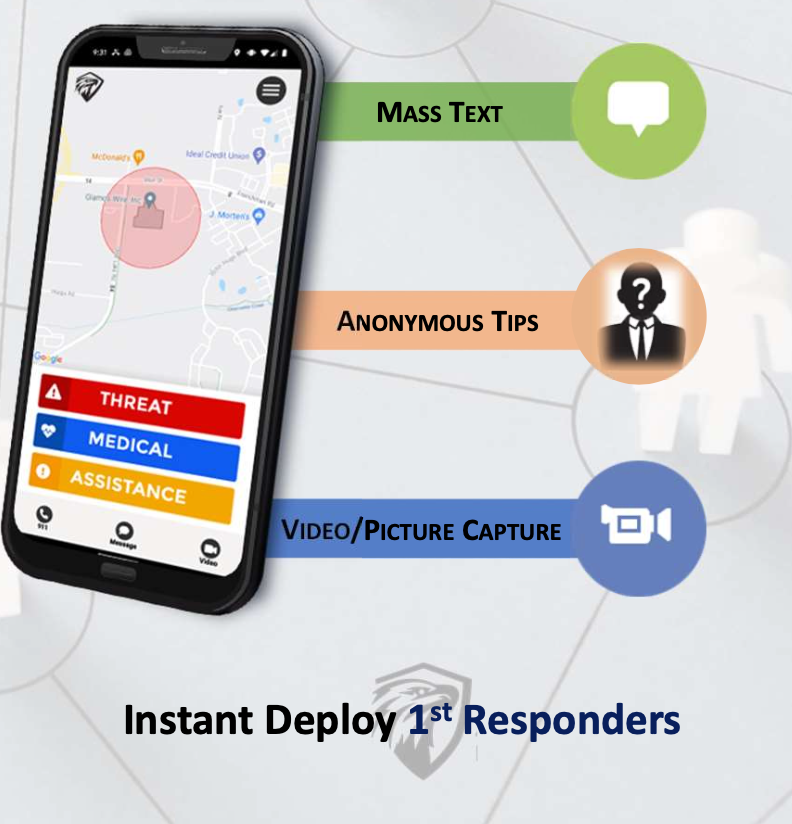
ALERT-COM® Crisis & Emergency Notification
Rapid notification for active threats, medical situations, anonymous tips and severe weather — one-touch from any staff phone, location shown on a site map, two-way during an incident, over encrypted infrastructure. It integrates with the layered stack, so a detection can trigger a notification without waiting on someone to relay it.
Cyber-Physical Monitoring FAQ
The questions we hear most from security directors and IT leaders evaluating converged monitoring.
What does "cyber-physical" actually mean here?
It means treating a device operating in your space as one category of threat, whether it arrives through a door, a network, or the air. A covert camera, a rogue access point, and a drone over the roofline are conventionally handled by three different teams with three different tools. Monitoring them in one picture is what closes the gaps between them.
How is this different from the security tools we already run?
Firewalls, NAC, EDR, and network detection all require a device to be on — or trying to reach — your network. SAFE Perimeter 360° sees devices that never connect at all. That is an entire category of threat those tools are blind to by design, not by weakness.
Do we have to replace our cameras or access control?
No. This is deliberately not a rip-and-replace solution. It integrates with video management, access control, intrusion panels, and your SOC workflow through API-based connectors. Where those systems work, they stay.
Does it require agents on endpoints or a network tap?
Neither. Sensors observe the RF environment directly and report to a cloud portal, with optional on-premise server. There is no agent rollout, no change window on production infrastructure, and no dependency on the network you are trying to assess.
Will the sensors interfere with our Wi-Fi, cellular, or medical equipment?
No. The detection platforms are passive — they receive RF and emit nothing. This matters in hospitals with sensitive biomedical equipment, in airports and seaports operating under aviation spectrum rules, and in SCIFs and other no-wireless zones where an emitting sensor would be self-defeating.
How precisely can you locate a rogue device?
Close enough to put a hand on it. A single sensor gives you an area; sensors working together give you a point. Because AirShield and AirShield-Mini units daisy-chain across a site, overlapping coverage narrows a transmitting device down to roughly a foot — and the threat-hunting app walks a member of your team to it in real time, on a floor plan, while it is still transmitting. That is the difference between knowing something is in the building and recovering it from behind a ceiling tile.
Can we approve some devices and block others?
Yes, and this is what makes it a perimeter rather than a sensor. You whitelist the devices that belong — staff phones, building systems, approved vendor equipment — and they stop generating noise. You blacklist the ones that do not, and they raise an alert the moment they appear. Policy is set per area, so a boardroom, a plant floor and a public lobby can each carry their own definition of normal, and a device that is fine in one place is flagged the instant it moves into another.
Does the AI act on its own, or is a person involved?
A person is involved wherever it matters, and you decide where that line sits. Routine, already-decided events resolve automatically — a whitelisted device is logged and nobody is disturbed. The majority are AI-assisted: the system classifies, locates, correlates against history and recommends, then hands the decision to your team with the work already assembled. Anything carrying legal, safety or reputational weight escalates to a named person and is never automated. Every step is logged — what the system saw, what it recommended, what a person decided and when.
Does the system get better over time?
Yes, and that is the point of leaving it on. On day one it knows the protocols. By week four it knows your building — which devices belong, where they normally sit, what hours they keep. Anomaly detection is only as good as the baseline behind it, and a baseline is earned through dwell time. The practical effect is fewer alerts rather than more: recurring benign patterns get learned instead of re-reported, so what reaches a person is what a person is actually needed for.
How does this handle privacy?
These are RF sensors, not content interception. They observe that a device is transmitting, what type it is, and where it sits — they are not reading messages, listening to calls, or identifying individuals by name. Collection is anonymized, and every deployment is scoped and documented so your counsel can review exactly what is and is not captured. We are not a law firm and this is not legal advice.
Own Your Airspace.
Every wireless environment has a different baseline. The fastest way to know what you are dealing with is a scoped Cyber-Physical RISK Assessment.
contact@safe-perimeter.com · (404) 590-6258